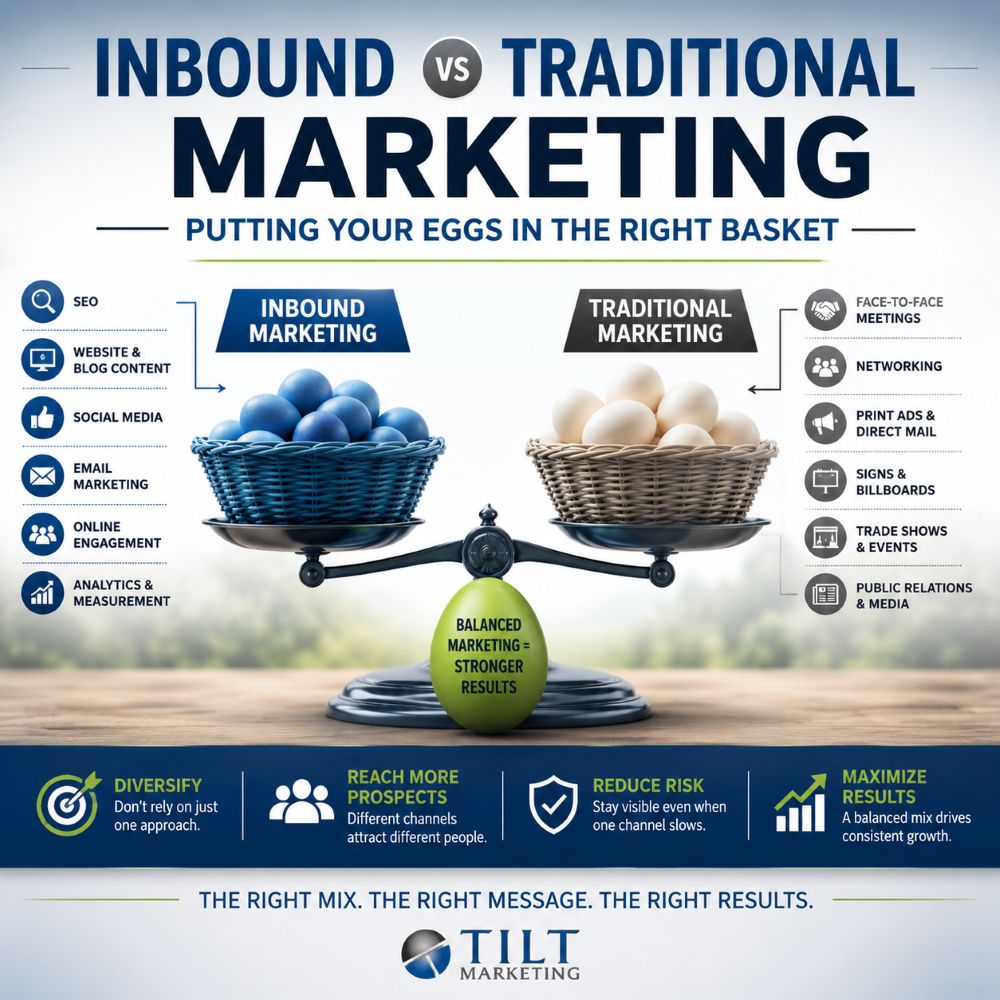
Inbound vs Traditional Marketing – Putting Your Eggs in the Right Basket
Editor’s Note: This article was originally published in 2019 and updated in 2026 with refreshed recommendations and additional insights for today’s businesses.
Traditional Marketing vs. Inbound Marketing: Which Approach is Right?
With 40+ years of marketing experience, including 25+ years leading Tilt Marketing, I’ve watched marketing evolve dramatically.
New tools and platforms continue to emerge, but one question remains surprisingly common: Should businesses focus on traditional marketing or inbound marketing? The answer is usually not as simple as choosing one or the other.
Are You Putting Too Many Eggs in One Basket?
You’ve probably heard the expression: “Don’t put all your eggs in one basket.” That advice applies to marketing too.
Over the years, I’ve worked with businesses that relied almost entirely on one marketing approach—referrals, trade shows, networking, advertising or online marketing. While those activities may work well for a period of time, relying too heavily on one source of business can create risk.
Several years ago, I worked with a company that had built much of its business through traditional marketing and referrals. For years, things worked well. Then market conditions shifted. Competitors changed. Buyer behavior changed. The company continued relying heavily on the same tactics that had worked in the past, while customers increasingly began researching products and services online.
Business declined dramatically, and the company came dangerously close to closing its doors. The problem wasn’t that traditional marketing suddenly stopped working. The problem was that customer behavior had changed, and the company’s marketing strategy had not evolved with it.That experience reinforced an important lesson: Marketing tactics should evolve as customers evolve.
What is Traditional Marketing?
Traditional marketing generally refers to more conventional marketing activities such as:
- Print advertising
- Direct mail
- Trade shows
- Networking
- Radio
- Television
- Billboards
- Brochures and printed materials
These tactics can still be extremely effective, particularly when targeting specific audiences or local markets. Traditional marketing also plays an important role in industries that rely heavily on relationships and referrals.
What is Inbound Marketing?
Inbound marketing focuses on attracting potential customers by creating valuable content and experiences.
Examples include:
- Websites
- Blog posts
- Search engine optimization (SEO)
- Social media
- Email marketing
- Videos
- Online resources
- Educational content
Rather than interrupting people with advertising, inbound marketing helps customers discover your business naturally while searching for information and solutions.
Marketing Has Become More Connected
Today people discover businesses through many channels including Google searches, AI tools, online reviews, social media, referrals, videos and word-of-mouth recommendations. Because of this, marketing strategies have become increasingly interconnected. People may first hear about your company from a friend, research you online, read reviews, visit your website and follow you on social media before contacting you. Marketing activities rarely work in isolation anymore.
So Which Approach Works Better?
Many businesses mistakenly believe they need to put all of their marketing “eggs” into one basket. In reality, the strongest marketing strategies typically include a balanced mix of traditional and inbound activities.
For example:
- Networking may generate awareness
- A website builds credibility
- Social media creates ongoing visibility
- Email marketing helps maintain relationships
- Content supports search visibility
Each activity supports the others.
Strategy Matters More Than Tactics
AI tools and technology now allow businesses to create content faster than ever before. However, technology does not replace strategy. Businesses often struggle not because they lack marketing activities, but because those activities become disconnected. The goal is not simply to do more marketing. The goal is to develop the right mix of activities for your audience, goals and budget.
Final Thoughts
Rather than asking whether traditional marketing or inbound marketing is “better,” focus on selecting the right combination of activities for your business. The strongest marketing programs rarely rely on a single tactic or a single source of leads. A balanced mix of marketing activities often creates stronger, more consistent long-term results.
If you found this article helpful, please share it on social media and connect with us online. Thank you!